
Convergence of a Parametric Symmetric Galerkin Boundary Element Method for the Mullins-Sekerka Flow
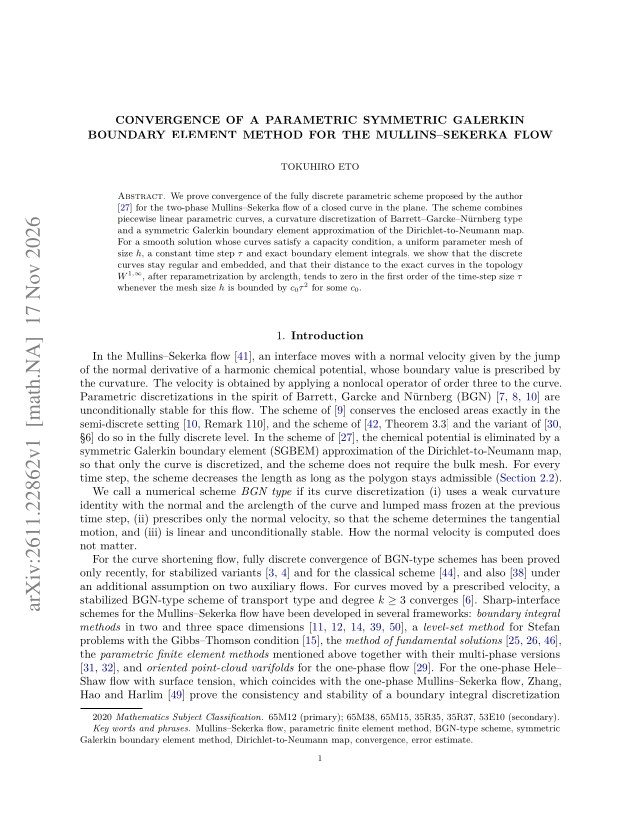
Convergence of fully discrete parametric schemes for the two-phase Mullins-Sekerka flow of closed planar curves had not been proved. The scheme in question combines BGN-type curvature discretization with a symmetric Galerkin boundary element approximation of the Dirichlet-to-Neumann map.
The analysis first proves uniform smoothness and a first-order rate for the time-semidiscrete scheme. It then compares the fully discrete polygons with the interpolated semidiscrete curves, splitting the error into consistency, linearized-step, and remainder terms. The linearized step is controlled in an adapted norm, following Rao's analysis for curve shortening. The main theorem and its auxiliary results are formalized in Lean 4 (v4.28.0-rc1) with Mathlib, on top of a separate formalization of boundary element bounds, relying on five stated external hypotheses.
For smooth solutions satisfying a capacity condition, the discrete curves stay regular and embedded. Their W^{1,∞} distance to the exact curves, after reparametrization by arclength, is O(τ) when h ≤ c0 τ². Theorem 1.1, Theorem 3.2, Lemma 3.3 and Lemma 5.5 are top-level theorems checked by the Lean kernel.
| Mathematical statement | Lean declaration |
|---|---|
| Theorem 1.1 | thm_1_1 |
| Theorem 3.2 | thm_semi_B |
| Lemma 3.3 | lem_3_3 |
| Lemma 5.5 | thm_1_1_superclose_h2 |