
$p$-harmonic polynomials
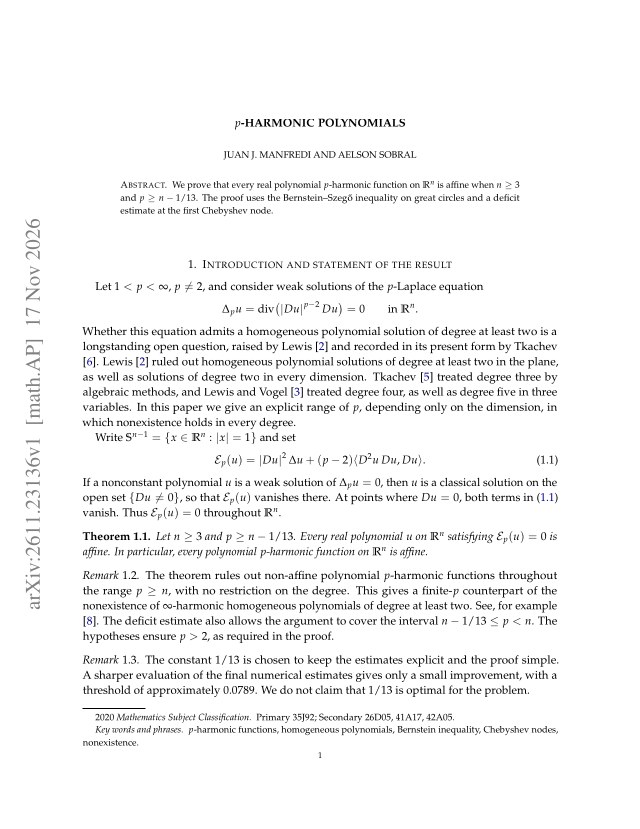
It is a longstanding open question, raised by Lewis, whether the p-Laplace equation admits non-affine homogeneous polynomial solutions in dimension n≥3. Prior results covered only low degrees.
The highest homogeneous part is normalized to attain its maximum on the sphere. The author then restricts to great circles to obtain trigonometric polynomials and applies the Bernstein–Szegő inequality. A deficit estimate at the first Chebyshev node, proved by Lagrange interpolation in the spirit of Duffin–Schaeffer, bounds the polynomial near π/m. Evaluating the equation at a maximizing point then yields a contradiction. The whole development is formalized in Lean 4 using Mathlib.
For n≥3 and p≥n−1/13, every real polynomial p-harmonic function on R^n is affine, in every degree. The paper reports a sharper threshold of about 0.0789 in place of 1/13, and all results are machine-checked in Lean.