QCCDCert: Formally Verified Compilation for QCCD Co-Design
John Zhuoyang Ye, Jens Palsberg, Ke Sun, Hartmut Haeffner
quant-ph
Nov 17, 2026 · v1
TL;DR
Implements a QCCD trapped-ion compiler in Lean 4 and proves an end-to-end theorem that compiled code preserves program behavior and satisfies the hardware rules given as inputs.
Abstract
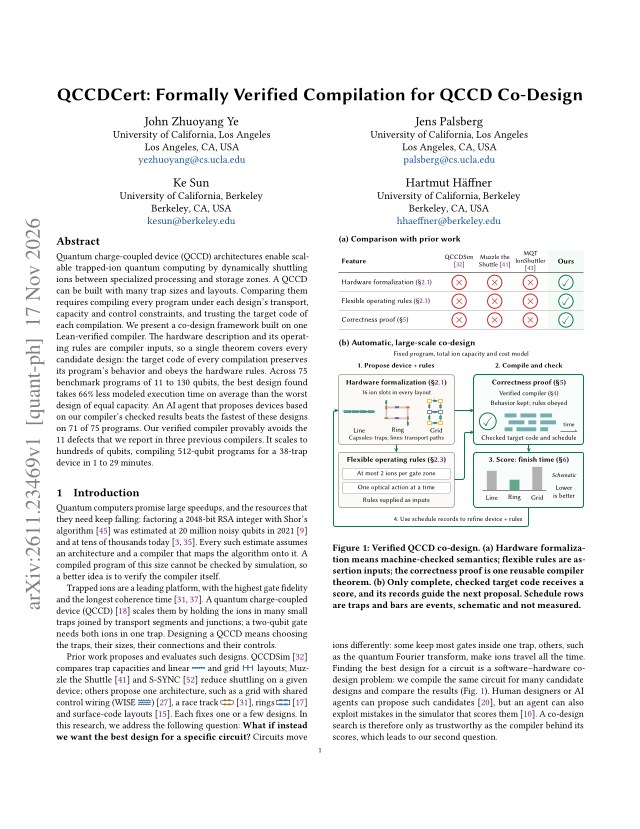
Quantum charge-coupled device (QCCD) architectures enable scalable trapped-ion quantum computing by dynamically shuttling ions between specialized processing and storage zones. A QCCD can be built with many trap sizes and layouts. Comparing them requires compiling every program under each design's transport, capacity and control constraints, and trusting the target code of each compilation. We present a co-design framework built on one Lean-verified compiler. The hardware description and its operating rules are compiler inputs, so a single theorem covers every candidate design: the target code of every compilation preserves its program's behavior and obeys the hardware rules. Across 75 benchmark programs of 11 to 130 qubits, the best design found takes 66% less modeled execution time on average than the worst design of equal capacity. An AI agent that proposes devices based on our compiler's checked results beats the fastest of these designs on 71 of 75 programs. Our verified compiler provably avoids the 11 defects that we report in three previous compilers. It scales to hundreds of qubits, compiling 512-qubit programs for a 38-trap device in 1 to 29 minutes.
Problem
Comparing quantum charge-coupled device (QCCD) trapped-ion designs requires compiling each program under every design's transport, capacity and control constraints. The target code of each compilation must be trusted. Existing QCCD compilers fix the device and come with no correctness guarantees.
Approach
A CompCert-style compiler with nine stages takes hardware descriptions and operating rules as inputs. Rules are expressed as assertions over per-instruction event frames, and broadcast transport under shared control channels is modeled as a primitive. Each pass is proved in Lean 4, and search-based passes are validated by proved checkers. The proofs compose into one theorem (verified_compilation) guaranteeing Meaning, Legality and Time. An AI agent uses checked compilation results to propose new devices in a co-design loop.
Results
Across 75 benchmark programs of 11–130 qubits, the best design takes 66% less modeled execution time on average than the worst design of equal capacity. The AI agent beats the fastest fixed design on 71 of 75 programs. The theorem excludes 11 defects found in three prior compilers, and 512-qubit programs compile in 1–29 minutes.